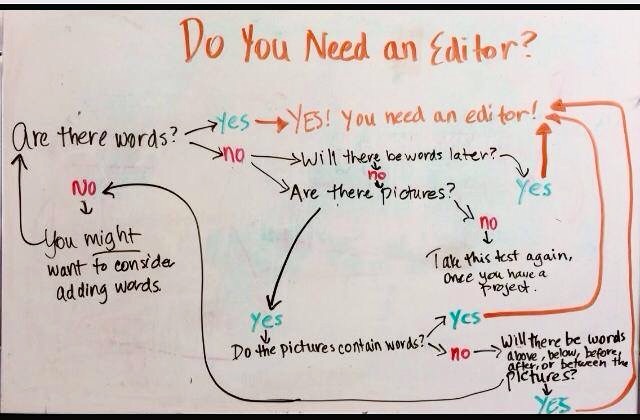
Do You Need an Editor?

NeedEditor

I’m sure it’s no surprise that I love this graphic. I don’t know whom to give credit, but it’s great. I wish I could show it to everyone who writes, whether professionally or on the side and in hopes of being published. Every type and piece of writing can be improved with professional editing. “Professional” is the key word.

Many people think they don’t need editors, I believe because they know how to read and write, took English classes, and maybe consider themselves to be good at spotting their own mistakes or errors on signs. They must think that’s enough. It’s strange coming across that. Some people are downright adamant and insist that they don’t need editors. I doubt many surgeons come across the same thing. How many of us would feel confident that we could put a screw in someone’s broken limb or even close a wound with stitches or staples (at surgeon standards)? I took biology and a health-tech. class in high school. Am I semi-qualified? Could anyone who likes to debate and knows a handful of laws do a lawyer’s job? I seriously hope that people would seek professionals for those services.

Should editing be an exception? I’ve learned so much as an editor, and when training to be an editor, that I never would have learned in regular, daily life. (Now, not all editors meet the standards, but I won’t go into that. I will upon request, though.) I don’t want to come across as having no sense of humor or discourage those with a love of language; it brings a smile to my face when I see that someone likes what I posted about writing or editing on my Facebook page, and I encourage people to keep learning about what they love. I just wish more people acknowledged editing as something truly professional–like it is. Let the pros handle your novels, your graduate theses, your business proposals, your websites. If you find a great editor, you’ll love the results. Sure, it takes some work on your part to find and hire the right editor, and there will probably be revisions to work on, but it’s worth it for something you care about–something you want to look its best.

Now, look at the funny graphic again and laugh!

Editor Amy

Errors We All Make

In any career field, there are notable greats. In editing, one of the better-known copyeditors is Bill Walsh, who edits for the Washington Post and has also written a few funny yet helpful books about language, writing, and editing. The man knows his stuff, and he even takes time to answer questions from the public when they struggle with writing scenarios or need a second pair of eyes (professional in his case) to look over tricky sentences. He recently came up with a list of twenty common errors that experienced and inexperienced writers routinely make: www.copydesk.org/blog/2015/03/26/20-nagging-errors-made-by-the-experienced-and-inexperienced-alike.

One instance that probably doesn’t get a lot of thought (but should) is saying something that includes the words “one of those,” which is the first item on Bill’s list. Look at this example and see if you can identify the correct verb: “Nikki is one of those people who drive/drives too fast.” I bet most people would choose “drives” because it links with “Nikki,” which is who we’re talking about, right? Nikki drives fast. That makes sense, after all. Technically, though, “drive” is the correct choice. The sentence is actually saying that Nikki is a member of a group of people who drive too fast (people drive). Bill reworded his example to make more sense, and it applies to mine as well. You could say “You know those people who drive too fast? Nikki is one of them.” I don’t care for the way the original version sounds, using the correct “drive,” so I’m likely to reword sentences like that to avoid the “one of those” phrase all together. This is definitely a common problem.

One thing I totally disagree with Bill about is number nineteen on his list: “The serial comma is done” (as in dead). (The serial comma is the comma before “and” in a series: “red, white, and blue” instead of “red, white and blue.”) Here’s why he considers it dead: He edits for a newspaper, and newspaper workers use the Associated Press Stylebook as their guide. Most other types of publications in America refer to books like the Chicago Manual of Style (my favorite), and the serial comma is absolutely called for. I’m surprised Bill actually made such a blanket statement when I know he’s aware that other style/reference books use the serial comma. My strong preference is for the serial comma, but I still tell people it’s a style choice and that consistency is important either way. When I edit books, I always ensure the serial comma is applied since most (if not all) American publishing companies require it. Plus, using it prevents a lot of cases of confusion/ambiguity, which is crucial in writing.

Check out the rest of the list for yourself. Are there any items you have questions about or disagree with? Any shared pet peeves? Let me know!

Editor Amy

Way-Back Wednesday: A Blast from My College Past

I was recently looking for something in a desktop folder that contains all kinds of files, and I happened across some of my college papers from my journalism classes. As you might guess, I adored all the writing and editing I got to do in them. What I’m posting below is an assignment I turned in (no stealing!) about my take on the importance of editing with regard to communicating. I’m not presenting it as a thing of beauty (I was still trying to find my style) but as more of a glimpse of the type of person I’ve been for a long time.


Editing: Quintessential in Communications

“I want to talk good and write good so I can do good and express what’s in my head.” Sure, that person has a lot of work to do, but he has the right attitude. To know the differences between “good” and “well” as well as “that” and “which” is an important task to achieve.

Recently I had a nightmare that an article I poured my heart and soul into got rejected by the city newspaper because I had made several inexcusable grammatical and punctuation errors. (The horror!) I have a goal: excellence. I want to be the best editor and writer I can be, in whichever field I choose, and inspire others to improve their language and writing skills. (I aim high, I know.)

Precision in language is of the utmost importance—at least, it should be. Reading an article and realizing that it comes across as something entirely different from what the writer probably intended is humorous at first, then tiresome, as it’s a never-ending cycle. People love to express themselves but often make simple mistakes that can alter their meanings. This must be stopped. Lovers of language should unite to politely inform those with blind eyes (figuratively) of their wrongdoings: inexcusable errors! Corrections would be made in masses, and expression would once again be smooth. “To,” “two,” and “too” could finally be universally understood. How glorious!

If only I could write about editing and communications all day . . . Alas, there’s much work to be done in the world. Many mistakes still need to be fixed, and most Wal-Mart customers still think that the “10 items or less” signs are correct. Language lovers and future editors should always carry permanent markers or corrective ink, whether figurative or literal, in case of editing emergencies. Maybe our fire for proper language and grammar usage will catch on. Right now there are several commas waiting for me to replace them with semicolons. An editor’s job is never over.